Case Study Example of Gender-Disability-Age Pay Gap Analysis

I have been taking an intersectional approach to data diversity analysis for some time and sharing these working with those who work on diversity data.

For people conducting gender equity audits, compliance reporting, or gender pay gap analysis, you may receive data from payroll, your data analyst, code the template and upload, and say bye bye. And then wait for the published summary report. Getting under the hood and checking raw data is worth the effort, as you understand how the data is put together for reporting. It can be complicated but worth the investment and you can quickly build you confidence.

Organisations can get fixated with singular figures and gaps between women and men, forgetting people with intersecting identities, age, cultural diversity, LGBTIQ, TGDNB, disability, Aboriginal and Torres Strait Islanders, and the combination of these. This then results in setting crude targets. You need to take the guess work out, and it’s tricky if you data literacy is not your strong suit.

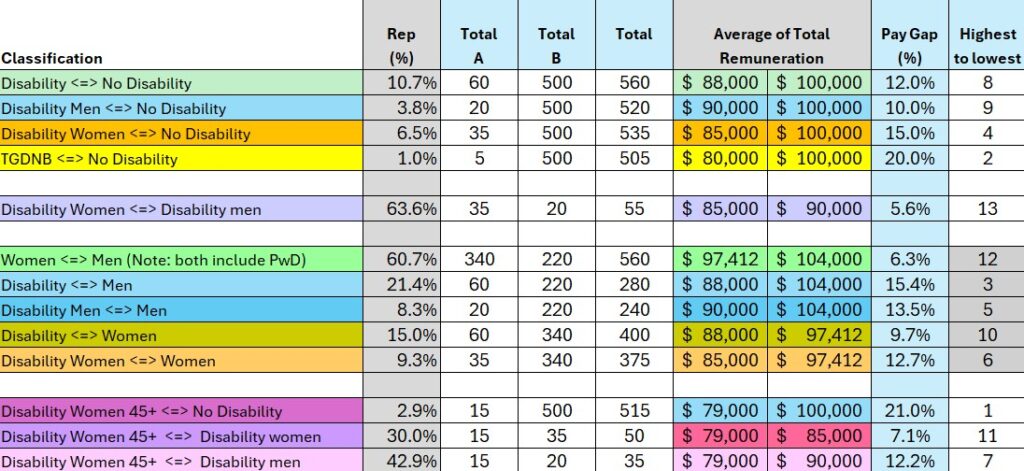
This is an example I created below (not real figures) that shows the average total remuneration pay gap and representation of employees – gender, disability and age.

You can dive into the data in a number of ways. The aim is not to have scatter gun approach or go down rabbit holes. Once you know the organisations better, or understand your context, you can be strategic in your approach by adjusting one variable at a time.

I am continually thinking of the human experience behind the figures, and what kind of disruption I can create in my actions. Not broad brush, but a few key targeted actions that will drive change. Over time the data will show transition of people into leadership (eg. manager and non-manager). The average current remuneration may give you a hint at what level employees may occupy (senior or junior position).

Making the complex simple takes practice. I like to construct a worksheet and practice calculations. You can also connect your data with other gender equality indicators or qualitative and quantitative data sets, looking for causes of the gap. Aggregate data often masks what is happening below the surface and result in crude targets. You can develop your own internal data sets and targets.

These are trends, but important information (even with incomplete data sets) that can help you identify equity issues and inform actions in your Gender Equality Action Plans. You don’t need to have complete data sets, but as you build confidence in your employees sharing personal information, they see why it benefits in evening the playing field.

If you are truly valued by your organisation, then being paid fairly is one of the ways that your value is recognized.

Enabling the Diversity and Inclusion Practitioner – current challenges to our profession

Roman Ružbacký

October 30, 2017

(From my opening address)

Welcome to the second day of the Diversity and Inclusion Conference (26 October 2017), brought to you by Employment Law Matters. I’m thrilled to be your host for the day. Following on from yesterday’s sessions, it’s shaping up to be another exciting and action-packed day. Five presentations, two panels and a roundtable, including the following themes, achieving true inclusion, why diversity programs fail, smashing stereotypes, disability, and cultural and linguistic diversity. I have been asked to provide some talking points, hot topics and fresh perspectives, that will align with the themes of day two.  

Diane Utatao spent some time yesterday talking about global issues, how world events in the past year have dramatically changed the world, cutting across all diversity dimensions, even big data and artificial intelligence. In the next seven minutes, I want to explore five key themes and ask five key questions (with a mixture of story-telling, self-reflection and enquiry), that focuses on the enablers, the diversity, inclusion and equity advocates and practitioners. We may call ourselves the tempered radicals with a steely resolve and kind hearts. So, I’d like to talk about ourselves and the challenges in our profession, in a local and possibly global context.

Part 1 –  A long awakening

I started my career as an analytical chemist, 24 November 1991, for a scientific research organisation. I would work away in my laboratory, often in solitude. I could go days without a conversation. It was an exact profession, requiring precision, timeliness, troubleshooting, critical interpretation of data with room for some creative thinking. The end game was to make a compound of ultra-high purity for the manufacture of magnesium metal. I could clearly see what our research team was trying to achieve. Of course, there was some politics and we were driven to find cheaper alternatives. But the result (good or bad) could be clearly explained by examining the methodology and isolating the variables, or combination of variables, that lead to a specific outcome. We’d re-run the process, time and time again, until the concept was proven and the best result consistently achieved.

On the flip side, I had a low consciousness in diversity, inclusion and equity. Although my lived experience of diversity was present at a personal level (refugee parents, low SES, single mother, CALD, sandwich generation, and disability in the family), I was impacted by inequality at a professional level (parental discrimination and being called a square peg in a round hole). I don’t think I was really engaged. I started working in equal employment opportunity in 1997.

My experience of parental discrimination, however, was the turning point in my career. And if I could experience discrimination, imagine how my colleagues could too. And boy, did they, as it become exposed to me through managing discrimination and sexual harassment complaints. This gave me some experience in finding where the systemic barriers and issues were hidden in employment practices and culture. I’ve always said that good D&I strategy reduces compliance activities.

As a diversity and inclusion practitioner, how do you change people’s deeply ingrained beliefs in relation to gender, race, age, pregnancy and LGBTI? Can you change people’s core beliefs through diversity strategy and compliance activities? You’d expect that clear evidence and rational argument would eliminate discrimination and sexual harassment, under-representation and under-utilisation. Not so, when we continue to hear about discrimination and sexual harassment in the media. It’s the one topic that appears to hit a nerve with people and it’s the endless comments section at the end of an article about promoting diversity and inclusion or that critiques power and privilege that is alarming, hurtful and harmful. You see people endlessly arguing their point of view and no one ever wins even if compassion is used as a rationale. Jane Elliot once said, “We know that anything you learn you can unlearn”. So, should we invest in ‘unlearning’ activities?

This brings me to my first question: How do you engage people, especially the unengaged? Story telling? Personal Experience? Appeal to their self-interest? Or, clear narrative and rationale? It’s a marathon not a sprint when trying to change people’s hearts and minds.

Part 2 – Who’s running the agenda

There has recently been an explosion of diversity and inclusion work and a new wave of emerging diversity and inclusion practitioners, managers and consultants across Australian workplaces. With the rise of practitioners, comes new and emerging practices, bold moves and claims, fad strategies, buzz words. It can be quite confusing.

Are you familiar with these concepts? Here’s a quick checklist.

·    Glass cliff, glass ceiling, glass elevator, double-glazed ceiling, stupid curve, jaws curve, scissor curve, bamboo ceiling, mansplaining, man-peating, man-terrupting, male champions of change, reflecting the community you serve, bringing you whole self to work, covering (appearance, affiliation, advocacy, association), code switching, lenses, narrative, Noah’s ark principle of diversity, the myth of merit, cultural fit (my favourite), diversity of thought, diversity fatigue, removing diversity altogether, fixing the women, the cement layer, the saviour complex, the good men that need to fix the bad men, hijacking the agenda, male privilege, and now the white middle aged male becoming an endangered species.

With this surge in D&I activity, people attend a few workshops, conferences, read a few articles and then become inspired, super enthusiastic D&I ‘experts’, then bring this back to the workplace expecting incredible and instant change. As D&I practitioners, we often need to temper expectations. We need to establish trust, credibility, respect and bring the people with us. And bold claims can also result in unrealistic expectations for seasoned practitioners when the methodology is not clearly explained or does not have academic rigour. You may then set the expectation for the unachievable, or unlike in my case, a long time ago, have your boss fudges the figures. Critical interpretation is critical too. If your organisation boasts, let’s say, 95% agreement of managers supporting gender equity, had one female executive and no gender equity plan. You can be led into a false sense of achievement.

There is constant evolution of thinking and some great practices out there. So how do you go about the work when everyone has an opinion on what to prioritize and how it should be done? Is our practice consistent? Should it be? Is everyone is doing the same thing and wanting the same outcomes? Are we considering work area challenges and contexts? What combination of strategies result in equitable outcomes? Can you pinpoint this? Can you prove this?

So, this brings me to my second question: Who is running the D&I agenda in organisations?

Part 3 – What is your organisations approach?

With a sea of information out there (and some imitation), it is difficult to find information that helps you to provide a clear narrative and rationale when talking about diversity, inclusion and equity; something with depth, academic rigour, that says something different. A call to action. A reason to act. You don’t want to be doing the same thing as everyone else and want to embed your unique style.

What is your approach?

  • Passive – Promotion, education, awareness, non-deficit language
  • Assertive – Women only positions, targets, quotas, KPIs, increased accountability
  • Scientific – Research, Benchmarking, Longitudinal Data, Evidence Base
  • A social model – People at the centre
  • Writing a strategy for people who are not there 

What is your personal approach?

My approach is trying to work myself out of a job! That would mean that the system is equitable. As a male working in gender equity (men, women, intersex), I am also aware of my place in the conversation. Would I feel a little apprehensive for someone to advocate on my behalf? Perhaps I would? How do I advocate for people when I have not experienced that inequality first hand? Is my voice being taken away, have I been tokenised or empowered? Am I there to enable, save or fix? What can I learn from people with disability about new ways of working and innovative practices. Has that campaign hit the mark? Are the good men trying to fix the bad men? How do the good men examine their power and privilege? Do I question my own privilege when designing strategy? Do I understand how deep this work runs?

From a recent account from “Unique leadership of minority women conference outcomes, Dr Diann Rodgers-Healey” she made the following observation: “What was common in all the reflections was that the challenges are always present because as minority women, they do not fit the norms that are accepted in society and in workplaces. What resonated through the presentations and discussions was the intensity of this impact on a daily basis, as well as the intensity of effort, emotional and physical, required to from workplaces and social contexts where norms define who is in and who is out, where normative lenses cloud seeing the overt and covert shades of exclusion the minority women traverse and the effort required to ‘fit in’ to unaccommodating discriminatory structures and discourse in workplace and society.”   

So, my third question is: Are all voices being heard in setting the D&I agenda? Are the architects and decision makers from diverse backgrounds? Is the profession homogenous in its composition?

Part 4 – Positioning of Diversity & Inclusion & Equity

Successful organizations ensure that the D&I role is positioned high enough to have autonomy, freedom in decision making, licence to operate, be creative and innovative and adequate resourcing. If you’re a diversity practitioner or manager buried five layers down in an organisation and flying solo, it may be a struggle to influence the agenda (yes, the one you have designed or have coordinated in partnership with your stakeholders). How do you demand accountability from executives when you don’t have autonomy or authority?

And, looking at LinkedIn profiles, my guestimate is that most organisations have one or two practitioners? There are currently large research teams working in medical research to try and cure cancer, so if we genuinely want to achieve equality, what can’t we do the same?

So my fourth question is: Do you have license/autonomy/resources to operate? Is it easy to do work at your organisation?

Part 5 – Do all roads lead to culture?

WGEA’s Australia’s gender equality scorecard 2015-2016 shows that 70.7% of organisations have a gender equity policy of strategy in place. There were 4697 organisations that submitted a compliance report to WGEA in 2016, that addressed seven key employment matters. That’s a lot of strategies (3320). However, there were 16% women CEOS, 28.5% women KMP, a national pay gap of 15.3% between men and women. 106 organisations were awarded WGEA’s Employer of Choice citation (public sector not included). That’s 2%.  So, with all these strategies and effort, and the glaciers melting faster than the pay gap, do all roads lead to culture as the key contributing factor to inequality? (my final question).

As diversity, inclusion and equity practitioners, we often want to be bold and courageous as the cause is very personal and the impact real.

I have tried to unpack some of the multi-layered complexities and challenges of the Diversity, Inclusion and Equity practitioner in today’s climate, as we strive to ensure that,

All people have a right to be treated with dignity and respect, and participate in all aspects of work life to achieve their full potential, where diversity and inclusion is a lived and breathed experience.

I wanted to finish with a quote from Winston Churchill,

“Every day you may make progress. Every step may be fruitful. Yet there will stretch out before you an ever-lengthening, ever-ascending, ever-improving path. You know you will never get to the end of the journey. But this, so far from discouraging, only adds to the joy and glory of the climb.”

Today we have a fantastic line up of speakers, thought leaders and change agents that will add great value to our thinking and practice. I hope you enjoy the day.

Intergenerational Diversity and Exclusion – lifting the cloak of invisibility

Roman Ružbacký

June 1, 2019

Many organisations across Australia now see Diversity and Inclusion as a business imperative that contributes to productive and happy workplaces. McKinsey suggested that gender and ethnic diversity are clearly correlated with profitability.  With greater diversity (cognitive and by attribute), including diversity conscious and inclusive practices, job satisfaction, job engagement, career development opportunities and retention improves. Homogenous teams have their limitations in design, problem solving and decision making.

In the last few years organisations have become better at sharing their diversity and inclusion strategies, gender, accessibility and LGBTIQ action plans on the internet. Having access to this useful information is helping to move the dial. When you search for a gender action plan, you will find over a hundred plans. However, when you search for an age and/or intergenerational action plan, there is not much information on-line.

Intergenerational diversity still appears to be in the shadows of other strategies, receiving minimal exposure in mainstream D&I practice in organisations. There doesn’t appear to be a concentrated and collective effort in developing a strategy encompassing four generations in workplaces. The same could be said about culturally and linguistically diverse action plans, which I wrote about a few years ago. This is probably due to many organisational prioritising other areas of work. D&I practitioners usually spin a lot of plates at the same time. Running a D&I program is a huge feat layered with complexity and emotion. 

Finding an evidence-based approach or model that looks at leveraging and fully utilising our generational diversity is not easy to do. I have read some work and strategies on life-stages, mature age workers 45+ and transitioning into retirement. I know a few people who have been researching and working in this area since the early 2000s (Z. Fell & P. Taylor) to name a few. I have been reading and collecting D&I articles for some years now and my age diversity library is quite thin! I expect a flood of strategies to be messaged to me after this read.

I’ve haven’t read through the details of the 496-page Australian Human Rights Commission’s Willing to Work Report, the National Inquiry into Employment Discrimination Against Older Australians and Australians with Disability (2016). I have also refrained from quoting the Age Discrimination Commissioner, the Hon Dr Kay Patterson AO, whom I have heard numerous times on radio and in newsprint, talking about persistent age discrimination in employment and those seeking employment. We could also look at median ages of organisations and workforce participation rates for different age cohorts to probably give us a fuller picture of who is being excluded.

“I have met older Australians who have sent out 200 resumes without one interview, or who are told to dye their grey hair if they want to keep their job, or whose employer can’t see the point of training them to stay relevant in their field.” …KP

I think we can easily underestimate the impact of age discrimination and exclusion. Older workers falling victim to ‘grey ceiling’ discrimination (Martin) or younger workers not being able to secure their first job. According to The New Work Reality report, 60 per cent of 25 year-olds enter the workforce with a degree. Despite this, 35 per cent are unemployed and underemployed because they are told that they do not enough work experience, lack an appropriate education of have poor career management skills.

Workplaces have changed over time. When my parents (Baby Boomers) were working in the 1970s and 1980s, they thought they had a job for life. They had job security and one wage could support a family. I remember my father telling me that in the late 1970s, he could quit his job in the morning and get another one in the afternoon, usually in the same street or suburb. But once they found a good place to work they stayed there for over 20 years. Working for one company and demonstrating loyalty was good advice from a Baby Boomer to a Gen-Xer back then.

In the early 2000s, both my parents were made redundant a few years apart. One after being given a golden watch for 25 years of service and being replaced by a machine. The other, made redundant after 23 years of service because the organisation failed to keep up with the times. Fast forward to the next two generations. People seem to work and move on every one to two years. Increased casualisation of the workforce and fixed term contracts, as well as increased competition, has made the workplace a different place today. This uncertainty and vulnerability impacts one’s economic security, well-being and self-worth.

Let’s talk about intergenerational diversity and exclusion 

I have waited a long time to write an article about intergenerational diversity and exclusion. And with some experience as a diversity and inclusion practitioner behind me, as well as my lived experience of inclusion and exclusion in various settings, I wanted to provide some insights on intergenerational diversity from a recent round table discussion.

Rather than providing a totally biased view on intergenerational diversity and exclusion, the opportunity arose through a series of round-table discussion, that helped me to glean more information on the subject and also present other people’s views. I wanted to examine more deeper-seated issues, such as, intergenerational exclusion, including under-representation, under-utilisation, discrimination (or unconscious bias), exclusion and generational clumps and clusters in pockets of organisations. It’s a subject that still feels taboo to talk about.

Making sweeping statements and generalisations about different generations is easy to do, as you will read further on. However, it feels awkward and uncomfortable to call out ‘age discrimination’ or ageism. Like the other isms, sexism and racism, we get a little uncomfortable when we need to talk about it. I have often heard the statement, I don’t see racism around here, but when you feel excluded because of your race, you just do. And when you feel excluded or invisible because of your age, you just do.

Ageism and exclusion cuts across all generations.

On one hand, as a younger worker, you might be familiar with the following scenarios and statements, for example, “you don’t have enough experience”, “you show maturity beyond your years”, your ideas not being heard by senior management, or being the youngest leader in the room in an executive team with that has no age diversity. 

On the other hand, as an older worker, you may be familiar with the following scenarios, for example, being told that you are over-qualified or over- experienced, or failing to get a job when you can demonstrate all the criteria, or being overlooked for career advancement opportunities, or rarely receive appropriate recognition for the contributions you make, or see younger people with titles of senior in them. One of my favourite movies is the Intern with Robert De Niro and Anne Hathaway, where De Niro is part of an intern program hiring older workers and his boss Hathaway is about 50 years younger than him. He went from invisible and useless, to being integral in the company, without worrying about issues around status.

Looking at issues in relation to intersectionality, age and other attributes can compound discrimination. For example, age and sex discrimination can play out together for women between 25-40. Think, potential pregnancy, pregnancy, parental leave, returning from parental leave and child rearing, and how this may contribute to gender imbalance in leadership. And on the other hand, we have heard the term, stale male and pale, being used to describe our politicians.

Insights from a roundtable activity

I’d now like to present some interesting insights from two 30-minute roundtable activities conducted with two groups of practitioners at a recent Organisational Development conference. I asked both teams to identify and unpack key issues on the theme of Intergenerational inclusion and engagement through a series of exercises.

But first, I asked both groups to complete a survey and rate the following questions between 1 and 10,

·      Does your organisation have a strategy (or action plan) on intergenerational diversity?

·      Do you personally feel that intergenerational diversity is an area of work needing attention in your organisation?

·      What is your current knowledge, skills and experience of intergenerational diversity?

·      Is there enough generational diversity in our working group?

I also asked participants to identify their strongest cognitive ability from the list below,

·      Social – Intuitive about people, Socially aware and Relational

·      Structural – Practical thinker, Likes guidelines, Predictable

·      Analytical – Clear thinker, Logical Problem solver, Rational

·      Conceptual – Imaginative, Visionary, Intuitive, About ideas

I grouped participants based on their cognitive strengths and abilities (cognitive diversity) and got them to work on four tasks in twenty minutes. I was aiming to bringing together multi-disciplinary teams to unpack and solve complex issues, a high performing team, all working to their strengths. I wonder if management teams fully utilise the diverse and often hidden cognitive abilities of their workforce and transcend positional status to do so?

The participants are shown in figures 1a (Group A) and 1b (Group B) below. I can provide a text transcript of these images on request to make them accessible. Please message me if you would like me to do this.

No alt text provided for this image

Figure 1a. Group A workings

No alt text provided for this image

Figure 1b. Group B workings

The results show the following trends:

·      Most people did not have a strategy on intergenerational diversity in their workplace

·      Most people personally felt that it was an area of work needing attention

·      Their current knowledge, skills and experience in intergenerational diversity was quite low

·      The first group rated themselves (on average) 4/10 for the level of generational diversity in their working group, compared to (on average) 6/10 for the second working group.  

Addressing complex issues in relation to equity, exclusion, discrimination and unconscious bias requires a diverse mix of people in the room to be able to solve them. So, what does this generally say about how organisations approach solving complex issues? Is there enough diversity in the room? Are we aware of our potential limitations if we don’t have enough generational diversity in our leadership? Are workplaces getting the most and the best from their people?

The four exercises

Once the cognitive diverse teams were assembled, I got them to complete the following tasks and their workings are shown below.

Social Group

I asked the group with strong social cognitive abilities to recall some of their own workplace experiences relating to intergenerational diversity, inclusion and exclusion, including stereotypical comments they may have overheard, including examining their own biases. Their workings are shown below:

No alt text provided for this image

Figure 2a. Group A – social group workings

No alt text provided for this image

Figure 2b. Group B – social group workings

So now that you’ve had had a chuckle over these statements, or felt slightly offended, what does it tell you about what people might be really thinking in your workplace? I felt that anonymity helped to free up conversations. Does your workplace make time and space to unpack these issues?

And, based on the assumptions and stereotypes captured in this exercise, are you conscious of your own surroundings and making impartial and objective decisions in your recruitment, career development, promotion opportunities? 

Structural Group

I asked the group with strong structural cognitive abilities to write down some of the benefits of generational diversity can bring to the workplace and how it may make workplaces inclusive and their people more engaged. I also ask the group to write down some of the impediments and limitations of not having intergenerational diversity and inclusion in their workplace. Their workings are shown below:

No alt text provided for this image

Figure 3a. Group A – Structural Group Workings

No alt text provided for this image

Figure 3b. Group B – Structural Group Workings

A preliminary analysis of the working indicates that generational diversity and inclusion appears to have the following benefits including:

·      Enhancing your organisation or team’s ability to be better equipped at problem-solving, design and service delivery

·      Being able to reach your target audience or customer base which is likely to be diverse

·      Utilising a wider range of accumulated skills and knowledge

·      Reducing group think

·      Having a more socially cohesive group

·      Openness to different working and communication styles

The benefits of generational diversity could also be measured through culture surveys, that indicate levels of job satisfaction, employee engagement, career development and retention from different generational cohorts. I would have liked a deeper exploration of the benefits, but as indicated previously, participants didn’t rate their knowledge, skills and experience highly before this exercise. 

Analytical Group

I asked the group with strong analytical cognitive skills to take a deep dive into intergenerational diversity, inclusion and exclusion, and look at identifying some of the complexities that would need to be considered when designing an intergenerational inclusion strategy.

They considered the intersection of age with other diverse attributes, for example, age/disability, age/sex (potential pregnancy, parental leave and return from career breaks), the sandwich generation (i.e., those with parental responsibilities for dependent children and caring responsibilities for ageing or sick parents). They also considered different contexts and challenges and tried to uncover any ‘diversity blind’ practices, for example, policies before All Roles Flex was introduced and flexibility embedded in organisations. A lot of discussion occurred within these groups, but there was not enough time to capture these.

This raised another interesting point. How to solve a complex issue under pressure and with time constraints? Do we spend time to read and research in our work environments? Do we make time for deeper reflection?

No alt text provided for this image

Figure 4. Group A and B Analytical Group Workings

Conceptual Group

I asked the group with strong conceptual cognitive skills to explore career life cycles and trajectories through different generational lenses. They had to consider the different stages of a person’s career, any pressure points that may affect a person reaching their full potential, for example, recruitment, promotion, flexibility, career interruptions, personal or organisational changes. The group had to also consider workplaces of the future.

No alt text provided for this image

Figure 5a. Group A Conceptual Group Workings

No alt text provided for this image

Figure 5b. Group 2 Conceptual Group Workings

So, what did we learn here? What appears to be consistent in both groups’ deliberations, was the point that career trajectory was not always linear. Disruption and change appeared to feature in both group’s workings. The two groups seemed to approach the task differently, one focusing on a cyclic career trajectory, where the other contemplated a person having multiple careers and having to reinvent or re-skill themselves. The other group looked at critical stages and pressure points of one’s working life and contemplated the personal and professional changes one might experience, some due to personal choices and others not.

Where do we go from here?

In bringing the groups together after each round table session, we were able to establish some of the key learnings from the exercises, including:

  • Understanding age-based assumptions and stereotyping: including having uncomfortable conversations
  • Fostering intergenerational dialogue encouraging collaboration and knowledge sharing: generations learning from each other
  • Promoting greater understanding and respect between generations
  • Avoiding under-utilisation of skills, exclusion and discrimination  
  • Bringing four generations of people in workplaces together in purposeful and mutually beneficial ways

I hope, that in a year or two, my intergenerational inclusion library will grow with plenty of action plans and strategies to choose from. And, that with four generations in our workplaces, that we break down any barriers and find commonality and appreciation of our strengths and differences.

Engaging with the backlash towards gender equity initiatives – insights from a male D&I practitioner

Roman Ružbacký

November 5, 2018

Do I really want to talk about backlash?

I was slightly apprehensive when asked to be recently interviewed about male backlash. It’s an issue that has been on the minds of diversity and inclusion researchers and practitioners for some time. Being familiar with some of the research and writings of Flood, Pease, Russell, Fox and Haussegger, et al., male backlash and its cousin, diversity fatigue, are entrenched and hard-wired behaviours.

The recent report, “Backlash & Buy-In”, by the Male Champions of Change consortium and Chief Executive Women, signed by over 150 male CEOs, suggests that male backlash is due to a lack of understanding of the business case for gender diversity, change fatigue, industry norms, cultural norms and fear.

I think there may be more to this.

As a D&I practitioner who has been working in gender equity since the late 90s, including developing gender equity strategies for organisations, managing discrimination and sexual harassment complaints, conducting numerous pay equity analyses, and preparing ten successful applications for the Workplace Gender Equality Agency’s (WGEA) Employer of Choice Citation, I’m going to explore some of the reasons for male backlash from a male D&I practitioner’s lens. I will also give some practical tips for individuals and organisations to enter the conversation safely and disrupt and dismantle backlash.

What is male backlash?

I have always come across some form of resistance to diversity, inclusion and equity work. The overt form of resistance includes the predictable and hostile commentary on social media, usually after articles like these, and usually outside of D&I circles. I’m more used to the passive kind of backlash, either the one that shows up in anonymous culture surveys, for example,

“Men have been actively overlooked for advancement in the name of advancing gender equity within the organisation”

But passive resistance also takes the form of a lack of effort by organisations to fast track gender equity initiatives in organisations, usually by resourcing it as you would a medical research team that was curing something that was thought to be impossible to cure. For anyone who has read qualitative comments in culture surveys, we can become immune to legitimate ‘issues’ being raised like a broken record. Structural or systemic issues still prevail. And when aspirational statements don’t match the effort or outcomes, then we see comments such as,

 “Family friendly and flexible work arrangements are generally words that are used, but don’t actually mean much.“

….which then leads to cynicism….

“Laughable that this Organisation gets awards as a gender equity employer, tells you how bad things are…”

The ever-changing resistive narrative

Over time, the resistive narrative has changed from, “We don’t discriminate around here”, “’We had 1000 men and no women apply for the role”, “We’re all about merit based selection”, “We can’t find the right women for the role”, “We can’t find the women”, to, “I’m sick of looking around me and all I see are blokes”, “It’s all about being flexible’, to some admission and greater comfort in men examining their own privilege. This is where the narrative gets tricky, because, does publicly stating that you are a man of privilege remind women that you are on top?

I don’t want to be critical about this progressive narrative, because if you asked me about gender equity in my twenties, I would have given you a blank stare, so how can I expect others to be on board, if they haven’t explored the issue more deeply? Even though, I can still recall clear moments of my professional single migrant mother battling all kinds of structural gender inequities, from trying to get a bank card or loan, to buying a used car and not being taken seriously. I was still gender blind.

However, something has changed over the last few years. When the conversation shifted from ‘fixing’ women to ‘enabling’ women (thanks to Fox, et al), when many women found their voice in the #MeToo campaign, and when representative targets started to make it into gender equity action plans, the resistance from some men became louder and aggressive.

As organisations become more vocal about their support for gender equity, there has been increasing level of backlash by men, and we need to continue to develop and challenge these narratives.

What is the nature of the recent backlash towards gender equity initiatives?

The backlash is coming in a few different ways, which I would classify into three categories.

Outright anger: It has been perceived in some circles that the middle-aged white male has become an “endangered species”. So, every attempt to even the playing field is met by loud and aggressive opposition (usually by a vocal minority), including claims of reverse discrimination. Perhaps some may feel that they are losing grip on their power and privilege, where you think there should be room for people at the top with the recent and significant growth in Victoria.

Passive fear: Perhaps more and more men are supporting backlash passively, because they remain silent on the topic. Their backlash takes the form of avoidance or zero acknowledgement, meaning that they worry about saying the wrong thing and therefore tend not to engage or are uncomfortable in how to enter the conversation.

Concerns about being labelled: Men are uncomfortable when labelled or called out for being sexist, or ‘mansplaining, man-peating, gender-washing, and hijacking the gender agenda’. And some are uncomfortable for all men when this happens, so they then apologize on behalf of all men or accuse the person (usually women) of labelling all men as bad.

It seems that backlash is an intense form of resistance. Do you have examples of resistance to your work as a D&I practitioner?

When I first started working in gender equity, the resistance usually started from a reluctance by the organisation to establish an evidence base, for example, conducting a pay equity analysis, or looking at issues related to under-representation of women in leadership. I once conducted a pay equity analyses for an organization, but seeing how bad the results were, I was sworn to secrecy and the figures later fudged.

In another instance, I was involved in setting up a leadership program for women. A year after the program started, it was a spectacular success that it abysmally failed. The backlash came immediately and in stealth from some of the executive men, who now realized that this group of capable women might gain a seat at the leadership table. They worked swiftly to mothball and derail the program. 

However, in the last decade, the intensity of effort in gender equity work has increased, our narrative matured and our collective consciousness lifted, so we have a better understanding of why we are doing the work and why the progress has been glacial for some time.

What are the reasons for the resistance to equality objectives?

There are a few reasons in my mind as to why backlash happens.

One major reason is many people don’t understand what the evidence is saying and so they tend to be dismissive of D&I initiatives. There may be a lack of a basic understanding of the key evidence, that shows under-representation, under-utilisation and discrimination (or a softer term, unconscious bias) that permeate society, and goes way back in time.

The “Stupid Curve” coined by former US Deloitte boss Mike Cook, demonstrates that Australian companies are still wasting a significant amount of the internal talent. Whilst, the percentage of women graduating from universities has been over 55% for the past 15 years (Alan Olsen), organisations still select nearly ~70% of their leaders (90% in 2008) from only 50% of the workforce (the male half). As a result, the other 50% (the female half) of the workforce is overlooked and underutilised.

There is a low consciousness of workplace gender issues. I once worked for an organisation that had an executive team of eight men and one woman, and an overall pay gap 20%. However, culture survey results showed that 95% of their employees (including the women) thought that their immediate supervisor genuinely supported equality between men and women. I couldn’t see how this result was even celebrated? I wondered if people had become used to the homogeneity and no longer saw anything wrong with it.

Our social conditioning (including the influence of social media) may contribute to how we perceive women in leadership, culture, power or authority, in an Australian context. The lack of diversity in politics, mainstream media, TV shows and commercials, helps to normalise stereotypes. And when women try to break through those stereotypes, they experience resistance 

Don’t make it personal. We have recently seen the emergence of powerful men advocating for change for gender equality, but in establishing their stake in the game, there appears to be a narrative that may need further refining, so that the message of why they are invested in gender equity is more than a personal issue, for example, having daughters that want a different or better future, or qualifying their interest by a narrative which doesn’t go deep enough. DeVries, suggests that organizational gender scholarship by male and female executives is critical to understanding the gendered nature of championing.

This knowledge can also impact the prioritising of gender equity in organisations (the gender agenda). For example, strategies that look at adopting gender neutral language and tackling sexism are important but need to be coupled with deeper structural and systemic issues, so that men don’t cherry pick issues in isolation to backlash against.  

The other reason is that the conversation around targets and quotas, and positions designed for women-only, is perceived by some as too interventionist and a type of reverse discrimination. It has probably divided men and women alike. What they fail to understand is that targets and quotas are usually a last resort and introduced after years of gently nudging people towards equality outcomes or throwing everything and the kitchen sink into their strategies. I don’t’ recall an organisation going out of business because of gender targets or quotas at executive or Board level. The reason why targets and quotas are not well understood, is that people have usually leapt into a conversation about targets, without understanding what has come before the contemplation of targets.

Organisations that have good leadership, critical mass and back the work usually can reach gender parity in leadership without targets, by creating an equitable and genuinely inclusive work environment.

Gender equity is also about getting men into feminised industries. Demographer Bernard Salt analysed the top 100 jobs performed by men and women, as recorded in the census of 2011 and 2016. Not much had changed. The greatest positive shift was the increase in female train drivers. The top male professions for both the 2011 and 2015 census were: carpenters, plumbers, electricians, builders. For women, it was teachers, childcare, health and aged care.

Another reason is that men in the middle of the organisation are being left out of the gender equity conversation. With the emergence of men at the top of organisations now championing gender equity initiatives, there has been an absence of men in the middle of the organisation doing the same. A recent gender equity expert has suggested that a coalition of male CEOs and men and women in the middle of the organisation may help get more men engaged in gender equity. 

Virginia Haussegger’s (Australian) research showed that 46% of men believe that gender equality strategies do not take men into account and that 42% of men and boys are increasingly excluded from measures to improve gender equality.

The last reason for the backlash is the lack of men in developing and driving D&I efforts may unconsciously exclude strategies to engage men and achieve gender equity, for example, parental leave provisions and encouraging men to work in traditionally feminized industries.

It’s been interesting to recently see women advocating for men, especially when it comes to new fathers. Does the messaging and imagery used to showcase recent articles on fathers fully explore the complexities of fatherhood. I have seen a lot of a good-looking bearded fathers holding their baby up in the air lately. My challenges have become more complex, and my needs for a supportive workplace, essential, as I’ve become sandwiched in the sandwich generation.

Men come in all shapes and sizes. Single fathers, step-fathers, foster fathers, fathers in a same sex relationship, men with multiple diversity dimensions, etc. Men who do not see themselves accurately represented in these situations, may feel excluded or misrepresented.  And a further exclusion may also occur when we don’t consider LGBTIQ in the gender equity conversation too.

And finally, few men work in HR departments and D&I, where most gender equity work occurs. If we don’t have more men doing D&I work, then gender equity may still be perceived as a women’s issue.

How can organizations approach D&I differently to bring everyone on the journey?

Organizations need to see D&I/equity proficiency and practice as a key management attribute. I think there may be general lack of ‘gender scholarship’ or proficiency in workplaces. Does the layperson need some basic proficiency in the science/evidence of gender inequity? Just enough to know what is going on? I look at my partner’s superannuation statements after 20 years of working, compare these to mine, and they tell me enough.

With a quick search on the internet, I can find current gender equity data showing the under-representation and under-utilisation of women in Australian workplaces, in the Workplace Gender Equality Agency’s August 2018 Gender Workplace Statistics at a Glance report.

For organisations reporting to WGEA,

·    Women hold 13.7% of chair positions and 24.9% of directorships and represent 16.5% of CEOs and 29.7% of key management personnel.

·     Nearly three-quarters (71%) of reporting organisations have a male-only team of key management personnel, and

·    28.2% of directors in the ASX 200 are women

Having transparent organisational gender equity data would help to fast track the conversation in gender equity, giving a clear narrative and rationale to doing the work. Looking through your organisation’s cultural survey responses to see if gender is even mentioned, or whether issues around backlash exist, is also helpful.

Economic security and empowerment have recently become a focus in many organisations, including addressing issues in relation to superannuation, qualifying periods for parental leave, removal of parental leave labels, centralised maternity leave funds, child care availability and affordability, under-employment and over-representation in casual employment.

With Australia’s population boom, there is an increased pool of emerging talent coming to Australia. With this growth you would expect to see more room at the top (leadership) in some professions, for example, the finance, service, health, education, transport, hospitality and even building industries. Gender equity strategies may need to become more sophisticated and consider gender and race together, or gender and other diversity dimensions.

Finally, the lack of male engagement and self-initiation over the long course of D&I work leads me to believe that structured spaces are not created for the critical conversations about gender equity in workplaces and to invite men at all organisational levels to be part of gender equity conversations. These may need to be written into gender equity action plans, and I believe some have already.

Where to from here?

Male backlash is not a new phenomenon. And my initial apprehension to speak about it in public domain, makes me wonder if I should have given this issue any oxygen? Can I see those pitch forks and fire sticks over the horizon? They are probably there somewhere. Have I brought more men on board? Have I taken a stand against backlash? Has speaking about it prepared me to have a conversation with other men about backlash? I think it has.

Diversity & Inclusion – Resisting the temptation for quick fixes

Roman Ružbacký

July 4, 2018

I recently attended a half-day D&I workshop.

During the second half of the workshop, the facilitator asked participants to come up with a list of actions and solutions to a problem shown on a cue card in three minutes.

Every table (of 6-8 people) had a different cue card, that had, something along the lines of, ‘How can we make this D&I initiative more effective’? I stared at my blank butcher paper in a state of confusion for the first two minutes, and thought to myself, I’m going to fail abysmally at this task by three.  

Many of the workshop participants went straight into fix it mode, and by the end of three minutes, I peered over long lists of actions on my table about things we can do better; for example, more targeted training, more promotional campaigns, t-shirts, fridge magnets, getting executives to do more stuff, etc, etc.

But when asked by the facilitator to identify the main challenge in achieving all the actions listed, the most frequent response was, ‘How are we going to get this all this stuff done without resources, money and time?’

But a bigger issue was still looming in my mind. At the end of this exercise, did we collectively, including me, arrived at superficial outcome – a ‘skimming the surface’ type outcome? Did we go deeply into the issue? I’m not sure we did.    

During this short exercise, I felt pulled into one direction and fought against it.  Do I attempt to be strategic or operational when solving a complex issue? Do I feel rushed or slow things down? Do I need to think faster on my feet? So instead of writing a list of solutions, I wrote a list of ‘problems’ and kept adding more ‘problems’ on top.

Something like:

1.     What’s at the core of this issue? Why is this relevant and to whom? What is the context? Does this issue have wider implications? Is there any evidence available? What is the data saying? Why have previous attempts at this initiative failed? (was it just resources, time and money?)  

2.     Do I know enough about the problem? Do I need to seek different perspectives? Am I not seeing something? What’s my bias in this? Where is my place in this? What makes this work relevant to those who think it’s not?  

3.     Do I have a clear rationale for doing the work? Do I need to establish an authorising environment to make this initiative work? Do I have the autonomy to make this work? If not, who can I influence? What levers can I manoeuvre? Can I be creative in my pitch and delivery?

I guess what I learned from the analysis of the outcomes of this exercise, is that we can often jump into fix it mode when we have a set of imposed rules, given time constraints or feel pressured in group situations to conform.

Quick fixes have short comings if you don’t think through the problem carefully.

Can I deliberately slow down to think about the best way to solve a complex issue under pressure? Just focus on one thing and do it right!!! Or do we think fast through complexity, like a formula one driver, who handles multiple tasks all at the same time, while having their mind on the end game. I guess we can all be quick strategic thinkers! 

Are we also open to different ways of learning and problem solving? I wonder whether a dominant or homogenous style of problem solving exists in different cultural settings too? Does it stifle creativity? Does it encourage resistance? Can I break the rules? Do I feel comfortable to say, sorry I’m just going to sit out this exercise and watch? 

How do I apply all this in real time and in the real world?

I think I need to take a Bex and have a lay down, or another workshop to figure this out!!! 

Diversity managers and the baggage of expectation

Roman Ružbacký

April 6, 2016

When I worked as an analytical chemist for a scientific research organisation, many years ago, I would work away in my laboratory, often in solitude. I could go days without a conversation. It was such an exact profession, requiring precision, timeliness, some troubleshooting, critical interpretation of data and room for some creative thinking. The end game was to make a compound of ultra-high purity. I could clearly see what our research team was trying to achieve. At times, politics and cost got in the way of quality. But the numbers (good or bad) were always reliable and helped me navigate through the labyrinth of research.

As a long term Diversity and Inclusion manager and practitioner, my experiences have been vastly different. This vocation involved lots of talking – day and night. Solitude was only ever found in research and reading. The main point of difference between these two professions was that my position description of Experimental Scientist did not indicate that I was responsible for other people’s actions or behaviours, whereas my PD as a Diversity Manager implied that I was ultimately responsible for the actions and behaviour of others. My performance as a Diversity Manager was largely measured by not only by the effectiveness of my strategy, but on how other managers and employees’ behaved and acted in accordance with Equal Opportunity legislation and how executives’ delivered on their diversity key performance indicators. Unfavourable results usually reflected badly on the Diversity Manager (for example a discrimination complaint) because it occurred on their watch.

As a Diversity Manager, how do you change people’s deeply ingrained beliefs in relation to gender, race, age, pregnancy and LGBTIQ? Can you change people’s core beliefs through diversity strategy and compliance activities? You’d expect that clear evidence and rational argument would eliminate discrimination and sexual harassment. Not so, when we continue to hear about discrimination and sexual harassment in the media. It’s the one topic that appears to hit a nerve with people and it’s the endless comments section at the end of an article about promoting diversity and inclusion or that critiques power and privilege that is alarming, hurtful and harmful. You see people endlessly arguing their point of view and no one ever wins even if compassion is used as a rationale. A leopard does not change its spots.

An organisation is responsible for the actions and behaviours of its employees in relation to discrimination and sexual harassment (vicarious liability). However, should the Diversity Manager or practitioner be responsible for the actions and behaviours of others? Especially when it affects the diversity and inclusion strategy they oversee or have authority to implement? Should they wear this burden of responsibility? This baggage of expectation cuts across many professions. Think of a great teacher who has a class of lazy students who bomb out on a test. Are Diversity Managers held to a higher standard of behaviour than the rest of their organisation? Are they meant to be saints? When I left one place, I was called the ’Conscience’ of the organisation. When I left another place, I was called the ‘Keeper of values’.

I keep an open mind about the realities of human behaviour. I think about how self-interest and profitability intersects or clashes with diversity strategy. Diversity strategy should not be a commodity or tool for exploitation. And, at all costs, I try to avoid practising the Noah’s Ark principle of Diversity, where we’ll have two people from each diversity cohort and diversity is achieved.

Recently, I tried to find all the Australian Diversity Managers on LinkedIn. I noticed a large proportion of Diversity Managers (or roles that combined diversity) had less than five years’ dedicated experience in the role and wondered whether in this was symptomatic of the profession. Is there a high burnout rate of diversity practitioners? It’s not a job for the faint hearted and many bones lie scattered on the diversity and inclusion highway. The work is intense. Diversity Managers often work in very small (or no teams) and have relatively small budgets but are asked to do a hell of a lot. In 2016, many organisations and small businesses were still at the foundation stage of their diversity and inclusion journey. This may suggest that some diversity strategies never get full traction or get mothballed.

Behind the position description of a Diversity Manager is the expectation that you will use your diversity strategy to change the organization’s DNA and reinforce its core values. How will you bridge the gap between policy and practice, rhetoric and reality? How will you use your diversity strategy to lift an organisation from being risk averse to authentic in its diversity practice, where inclusion becomes a lived and breathed experience?

In 2005, I attended Jock Noble’s presentation on the “Integral Model of Evolutionary Diversity”, which was affirmation to me. It detailed organisations’ D&I journey, beginning from compliance and moving through the stages of risk minimising, being competitive, aware, committed, reflective, aspirational, strategic to authentic. There was one statement that stuck with me and it was part of the authentic suite. It stated that an organisation that was authentic in diversity and inclusion reached the point where, “The community viewed the success of the organisation as representing their own success. They seek to protect and strengthen the organisation because they believe values it represents, represents the values they hold dear.” This concept completed the picture for me about the Diversity Manager’s role and its multi-layered complexity and dimension.

Another point I would like to make is in relation to testing your D&I strategy to see what really works and what doesn’t. Do Diversity Managers manage complaints to see where policies or processes don’t work? Is this essential? One adverse finding of sex based harassment can cost your organisation an Employer of Choice for Gender Equality citation (WGEA). A complaint of racism can undermine your Racism, It Stops with Me, Supporter Agreement (AHRC) as well as pose a huge reputational risk. Through my handling of discrimination and sexual harassment complaints, I was able to unpack highly complex, emotive and overlapping issues and apply the learning to uncover diversity blind practices and other systemic issues.

As a complaints handler, I’d often hear of awful life changing incidents and the impact of alleged discrimination and sexual harassment and at times, inaction, isolation, abuse of authority, wearing down of the complainant, to acute physical and psychological trauma experienced by all involved. This was very heavy work. At the end of a complaints process the organisation should be able to test their processes and practices and implement change and improvements. I usually saw the complainant being empowered by the process (if supported well), learning to establish boundaries of acceptable behaviour and dismantle power where necessary. However, they often became burned by the process, angry, isolated, forgotten, wore a cloak of invisibility whilst bystanders ran for cover and later on everyone forgot that the person ever existed. Who’s x, y and z you ask? (names of people subject to sexual harassment that we have forgotten).

If you have a large volume of staff and a large causal workforce, then you need to be aware of your blind sides. Are your causal staff engaged or trained in EEO? Are you looking on social media sites and posts to see if there are any issues in relation to discrimination? Are your managers consistent in the application of equity and inclusion principles, including flexible working arrangements? Are you seeing the red flags? Does the organisation become reactive and slow to respond when faced with a serious issue?

And finally, working in the area of human rights, equal opportunity, diversity and inclusion requires some emotional investment, a capacity to care for people and a self-monitoring regime to avoid burnout. It requires a fire in the belly, someone who can stay calm in the storm, be the voice of reason and compassion and be open minded. It is a job of little or no self-interest. And not to be naïve, people need to make a living doing this important work, but through this work there needs to be a genuineness, authenticity, some depth, empathy and sincerity. It requires you to go outside your comfort zones and not just view the world from your lens but embrace multiple perspectives. It requires Diversity Managers to even explore any issues of homogeneity in their own profession. It is not a job for the blindly ambitious or for those who want to make a name for themselves. It’s not about awards. It’s not for those who lack compassion whilst preaching inclusion.

I have always stood by the belief that the work in diversity and inclusion is more important than the organisation. It’s about the work. It’s not about looking good, fluffing the figures or just pleasing executives. At times, the role requires challenging the status quo, self-interest and narcissism. And you need to do this whilst keeping centred, objective, rational, holding your integrity, speaking your truth and a times walking comfortably on the fringe. You are not always going to be liked and that’s OK. Your empathy needs to be matched with an efficiency of pragmatic action and organised response from the infrastructural to the interpersonal. This often require humility, inter-personal communication skills and genuine empathy towards others.

So yes, as a Diversity Manager and practitioner, I take on this responsibility. I wear my scars (mostly hidden) like a badge and use these acquired and cumulative skills to continue to challenge and change a system that allows discrimination, sexual harassment, bullying and unfair and unreasonable behaviour to happen.

No one taught us how to write posts. We had to figure it out for ourselves.

Roman Ružbacky

November 20, 2023

Opinion Piece.

🌷🍂☘I joined this platform on 15 October 2009. And like many of you, who I have connected with here, who work in #HumanRights #Diversity #Equity #Inclusion #Justice – activists, advocates, allies, leaders and practitioners – I have written and shared a lot of material.

Over the last few years on this platform, I have been feeling pretty overwhelmed. I’m continually feeling like I’m looking at lines of code of the Matrix running down my screen. It’s become very fast, short grabs, high in visual content. I’m lost in a sea of information most of the time. The bulletin board is like a car passing library shelves filled with books. The overload can send me away for days on end.

I think my behavioural insights colleagues would say that I have been conditioned, influenced, adapted to and putting up with the system? I have probably contributed to this fast-consuming culture by adapting and at times walking a fine line about what should I post, how long, what is the visual, the style, the format, the length. And when I first started, it was an article I’d be working on for two weeks and would have edited 15 times.

Perhaps in our current time, people are trying to figure out the algorithm; crack the code to higher viewership? Have I not understood the full functionality of the platform? My user experience in the last few years has been pretty overwhelming and underwhelming. There’s no reward for long term contributors. And I feel I do a disservice in not being able to read the quality work and efforts people put into their work. I’m finding I’m not paying enough attention to good content, and new writers, and this can lead to pushing out comms – like one way traffic. Quick likes and reposts can become an obsession.

Well, something I have started doing again in 2023, 14 years late is consciously reading the lengthy posts and reports, that I save to my desktop. I’m back to writing more lengthy posts and in-depth articles. I still remember going to the library pre-email and internet to look at journals, newspaper clippings and literature searches. Perhaps a bit of old school coming from this Gen Xer.

Around 2009, and with only 168 connections till about 2016, I used to spend a few hours at a time, stop at every few posts and read personal articles written by our #Diversity #Equity #Inclusion community, links to DEI research, opinion pieces and new work. I liked reading from new DEI practitioners and supporting up and coming practitioners.

I enjoy reading posts on topical issues, on issues that need the attention on politicians and leaders. I like people who have a clear and independent voice, who are brave and speak hard truths.

Don’t get me wrong, there’s some great material around (in a sea of information), some incredibly great movements and increased comfort in sharing of lived experiences (it’s not always a safe place to do this). The conversation in DEI has matured. The emergence of lived experience voices has been a revelation. The intensity of effort to want to see change increased. The platform can be highly charged. It can also be filled with fandom, shallowness and over confidence. It can also be used to include or exclude. It can also include over sharing. And meanwhile, with all this effort, the pace of change still glacial, but forever optimistic that it will change. 😮😲😞

I’ve tried searching hash tags bulletin boards, for example, inclusion, diversity, equity, intersectionality, but pretty much the same. Is it because of a significant increase people in the profession? Or the 950 million users? And despite of this we can still feel like we’re in a vacuum. In a school yard with the same people. 😏🤔🙃

Is there a filter that can be built into the system (or one that I don’t know about) to give the user an option to either see: a) photos (selfies and awards) b) personal reflections b) events and forums c) personal articles d) polls e) links to shared news content f) new positions started g) launch of new DEI work – research and reports h) space for new writers. Or even a function that allows you to have your own personal on-line library of information to access? (Well I created my own!) 🧐😑😎

It’s interesting that I’ve moved almost completely away from a physical library to a digital one in the last few years. I still have newspaper clippings of articles and around 100 folders of articles and case studies I used to print out (not a good carbon footprint -will recycle these). I’ve never had a cluttered desktop before. And the pandemic contributed to this.

I guess it’s a personal choice of how you chose to engage and interact. Similar to the days of emails, no one taught us how to write them. We had to figure it out. And maybe that’s part of the platform’s evolution. It’s only one method. I’ve come back to old fashioned coffee catch ups, phone calls, emails and texts, three- dimensional communication. And prior to emails, it was paper notices in pigeon holes with you name labelled on them. Those were the days! My behavioural insight colleagues would have something to say about that too. 😁😕😂

Disability strategy in the shadows as disability discrimination complaints tops the list year after year

Roman Ružbacký

February 9, 2016

Reading through many superb diversity articles in 2015, as well as discrimination and sexual harassment complaints in the papers and the Australasian Legal Information Institute, it wasn’t difficult to predict where organisational diversity and inclusion practitioners would invest their resources. It was hard to find anything that showed the same kind of examination, urgency, rigour and measurement in the employment sector as the Workplace Gender Equality Agency, Sage’s Athena Swan, Male Champions of Change or Pride in Diversity’s AWEI index. Good governance, compliance and a culture of non-exploitation would hopefully tackle the rise in employment activity discrimination. And, Unconscious Bias training, a more sophisticated anti-discrimination measure examining power and privilege, when done well, was quite effective.

Yet again in 2015, and for some time now, Age was generally seen as the ‘sleeper’, race and faith (whilst making the news headlines on a weekly basis) was still experiencing a high degree of complacency, and disability …. in the shadows (invisible). Mental health strategy – didn’t we talk about that a few years ago?

The Victorian Equal Opportunity and Human Rights Commission’s annual reports shows the number of issues raised in relation to discrimination and sexual harassment, complaints lodged, the grounds for complaint and the area in which the alleged discrimination occurred (example, employment, education, goods and services, etc.). The Fair Work Ombudsman also has similar data, but has disappointingly only managed a few hundred discrimination complaints a year in recent years (based on their reports).

Table 1 below shows the total number of complaint lodged at the VEOHRC in the area of employment and the top five grounds for complaint in the past three years. Disability continues to top the list for as long as I can remember. The number of complaints between 2013 and 2015 was 344, 340 and 355 respectively. It would be interesting to know, where multiple grounds for complaints were reported, which of the grounds intersected.

Table 1. Top discrimination complaints lodged at VEOHRC

Table 1. Top discrimination complaints lodged at VEOHRC

Employment                      2013       2014       2015

Disability                              22%        22%        21%

Employment activity       11%        14%        11%

Sex                                         9%          7%          11%

Race                                      11%        11%        10%

Sexual harassment          10%        12%        10%

No. of complaints lodged              1574       1540       1670

Table 2 below shows the number of enquiries made (issued raised) and complaints lodged by Victorians to the VEOHRC and the grounds of alleged discrimination. The results were not disaggregated by area, for example, employment. Disability, once again, had the highest number of enquiries and complaints lodged.

Although the figures may suggest that information provided by the VEOHRC to people making enquiries may have been sufficient enough to resolve their issue, they may also indicate other deeper or systemic issues, often identified by complaints managers, advocates and support people.

These may include, being afraid to make a complaint, lack of confidence in lodging a complaint or in the system, fear of victimisation, fear of fracturing your professional relationship, being too exhausted from being subjected to discrimination, having to prepare a complaint while you are working under pressure, being isolated by colleagues when you make a complaint and feeling like you need to prove how you are being discriminated. These all lead to under reporting. We need to ask why the number of complaints lodged is so much lower than the enquiries made (see Table 2). Calling VHREOC in relation to a discrimination issue is a big step.

Table 2. Number of enquiries and complaints in 2015

Category (areas)               enq.       Compl. Compl.

                                               No.         No.         (%)

Age                                        500         145         29%

Parental status                  358         111         31%

Carer status                        377         123         33%

Sexual harassment          542         183         34%

Disability                          2178       752         35%

Race                                      850         307         36%

Sex                                         590         235         40%

Sexual orientation           155         75           48%

Employment activity       387         188         49%

Victimisation                      518         328         63%

Total                                      13877    2977       21%

However, getting back to the issues of disability strategy stagnation, the most important piece of information I have uncovered as a practitioner was from the design and results of a diversity survey. Whilst the number of reported incidence of discrimination on the grounds of disability was very low, people with disability were over-represented in reported incidence of unfair treatment in mainstream employment situations, compared to any other cohort. Employment situations included, workload allocation, promotion, career progression, remuneration, recognition, performance review and access to career opportunities. Based on this information, organisations could closely examine its diversity conscious and diversity blind strategies, and pinpoint where intervention, prevention or action is required.

Based on this finding I then started to question my thinking around covert or overt discrimination based. Does covert discrimination really exist? It depends on who’s lens you are ‘looking’ through. What I see as covert discrimination may be seen or experienced as overt discrimination by someone else, even if they can’t clearly articulate that their unfair treatment constitutes discrimination.

Diversity and HR practitioners must not wait for an agency to appear on the horizon to bring disability in employment out of the shadows. Perhaps using existing models (for example, AWEI and WGEA) and the evidence from VEOHRC, the elimination of disability in employment will be done with greater urgency, rigour and measurement.

Gender inequality in Australian workplaces – are you tired of hearing we need to do more? (Part 2)

Roman Ružbacký

March 8, 2016

On the eve of International Women’s Day, I began to hear once again the familiar sounds of CEOs and politicians responding to the calls for action in tackling gender inequality in Australian workplaces, with the following familiar catch phrases, “There’s more to do…. We must do more …..We have a long way to go….Everyone needs to play a role here… We need to work together……We have to ensure that all women have….. It’s the right thing to do…” It appears to be a reoccurring theme.

Is this humility, an apology, laziness or complacency? Are these throw away lines that feed our hopelessness about the situation? Stagnation? Statistics that won’t improve? I can’t use ‘glacial movement’ anymore because even our glaciers are melting away faster than our pay gap. I’d prefer to hear .. “We have thrown everything at it…. We are doing everything we can… We have left no stone unturned…..” This narrative would give me more hope.

When Canadian Prime Minister Trudeau was asked by a reporter why he decided to put 15 men and 15 women in his Cabinet. His answer was a short one: “Because it’s 2015,” he said, to cheers and applause from the audience. I applauded at my laptop when I first read the article on-line. Underneath this statement lays a deeper understanding of the issues that lead to this magnificent outcome.

When we talk about gender inequity, we usually find ourselves engaging in deficit language. This is because the evidence shows that it is not an even playing field between men and women in Australian workplaces (WGEA, researchers, et al..). And, if I were to look through an organisation’s gender compliance report, of which most are available to the public, I will most certainly find some gaps. I haven’t seen an ASX 500 publish a zero percent pay gap to date, not to be confused with in-band pay gaps, as one CEO did on Q&A.

So, how do I engage in a conversation about gender equality in my workplace and make someone care enough about it? Does the layperson need some basic proficiency in the science/evidence of gender inequity? Just enough to know what is going on? I look at my partner’s superannuation statements and they tell me enough. To work in gender equity, I had to first eliminate my own self-interest, understand my own privilege and get a better appreciation of my own gender blindness, such as the value of unpaid and invisible work. My skills sets have been further developed since I became a stay at home dad for the past five months.

So you have a supportive and inclusive culture (and you believe it) .…what next? Gender inequity needs to be explained with more rigour starting with the Stupid Curve (representation) and explanation of the pay gap between men and women. Employees should know their organisation’s pay gap and what it actually means? Most organisations are secretive about their pay gap. However, if I were to do some math based on workplace profile data, it would be too difficult to estimate.  

The lack of representation women in executive positions is more obvious. Look on enough company websites to see homogeneity alive and well in Australian workplaces as well as a lack of visible difference. Organisations need to get better at explaining why gender inequity exists in their organisation and perhaps be more transparent about the parts they may perceive as contentious.

A combination of complex variables come into play when examining how gender equity operates in Australian workplaces. Establishing a longitudinal evidence base, drilling into aggregate organisational data (which can mask what is happening layers down an organisation), critically interpreting the data and understanding the complexity and connections between different evidence (data sets), prior to having the conversation with an executive about their gender KPIs, would prepare you for a conversation about effective strategy. And before I open my mouth to speak about gender equity, I usually anticipate with great certainty that I will be told, “We’re all about merit based selection”, “We don’t have the pool of women” or “We had 100 men apply for that engineering job, no women”. This has changed from the old “I don’t see discrimination here” (we hope).

Here are a few points that I hope will to add to your evidence based discussion, familiar to those who work in gender equity and useful for those who are new to the area.

  1. The “Stupid Curve” demonstrates that Australian companies are wasting a significant amount of the internal talent. Whilst the percentage of women graduating from universities has been over 55% for the past 15 years (AFR – Alan Olsen), the transition into executive, director and CEO level is low. Organisations select nearly 90% of their leaders from only 50% of the workforce (the male half). As a result, the other 50% (the female half) of the workforce is overlooked and underutilised. Longitudinal data may also show a slower rate of transition of women in senior positions than men. I usually bring a copy of the graph when speaking with executives about their gender KPIs.

When overlaying your organisation’s workplace profile data on this curve you will be able to quickly establish if your organisation has a similar curve. You will also be able to identify if there is a pool shortage (for example in STEM disciplines) or whether this is a myth that needs debunking. You can also establish the rate the pool of women and men move into senior leadership positions via promotion, exit and recruitment. You can also drill into the different portfolios and make comparisons with the organisation’s or industry’s aggregate data. Different areas will have different challenges which then allows for the design of tailored gender equity plans, further measurement, then further redesign and implementation. You could also overlay your graph with women from CALD backgrounds, Indigenous women, parents, non-parents, lgbtiq, disability, and apologies if I left anyone out. You may be able to pinpoint the glass escalator, glass ceiling and glass cliff in your graph.

What you’re also trying to demonstrate is the potential limitations of homogenous leadership, the lack of multiple perspectives in decision making, not utilising the pool of talent available to you and potentially not being reflective of the customers or community you serve. After a few years of helping to run a gender summit for a STEM university faculty, I heard a senior male leader say, “If we had gender parity, we would double our enrolments”. I use this quote often.

2. In exploring factors that contribute to the Stupid Curve, you will find some that may be beyond an organisation’s control, for example, child care availability, affordability and the lower participation rate of women in the workforce (59% in 2015), compared to 71% for men (WGEA). The participation rate of men with children between 0 and 5 was 94%. Women experience higher under-employment and are usually over-represented in the casual pool.  

3. Another factor that contributes to the Stupid Curve is the impact of career breaks on women, the intersection of potential age and sex discrimination around the ages of 25 to 45 (potential pregnancy, pregnancy, maternity leave and return from maternity leave), gaps in parents’ employment history and being too expensive to employ.

 4. Job design is another critical issue that contributes to the Stupid Curve that can’t be fixed by flexible working arrangements alone. Drilling into your workplace profile data and checking the number of part time women and men occupying senior positions will give an indication if this figure is low. If it is, does this suggest that your organisation’s management positions can’t be done part time or by job share arrangement? Do your part time employees try to fit five days work into three? What is their reality?

 5. In relation to unconscious bias, I often feel that this the new buzz word used to hide the fact that you may have been discriminating. However, unconscious bias training should help to raise your gender consciousness and gain a better understanding of your own power, privilege and affinity bias, with the result of you making conscious decisions to be more inclusive.

 6. The pay gap between men and women, which reached its highest point of 18.8% in November 2014 and hasn’t improved in 25 years, seems like the immovable mountain. The gender pay gap is largely structural and caused by the over-representation of men at senior levels with a corresponding over-representation of women at the junior classifications. The best way I can explain the structural issue in lay person’s terms, is that if you had 10 men and 10 women earning $10 a day; that’s $100 paid to your all of your women and $100 paid to all of your men. The average total remuneration for your men and women would be $10 respectively, resulting in a 0% gap. If you were to then introduce an additional 10 women into your organisation and pay them $2 a day, then your total number of women in your organisation would be 20 and the total amount paid to your women would be $120. $120/20 women equates to $6 a day for your women whilst your men are paid $10 a day. There’s your 40% pay gap.

The pay gap between men and women at executive level is also a contributing factor to the organisation’s overall gender pay gap where bonuses and incentives are awarded/eared by executives. Usually the level of responsibility and complexity of their portfolio results in a higher total remuneration than other employees in their portfolio. When drilling down into your organisational data, presenting the data with and without your executive’s remuneration helps to get a more accurate reflection of the portfolio’s pay gap. In band pay gaps, usually at each classification level, are different to the organisation’s overall pay gap and many of these gaps may be close to 0% because of fixed pay rates. Care needs to be taken that your ongoing and fixed term employee pay equity data is separated from your causal employee pay equity data as the casual data will dilute your overall pay gap and make your overall gap much lower, usually due to the higher number of women in your causal cohort.

However, a hidden pay gap which is very difficult to measure, and I saw live and well in a HR department, was women at lower classification levels working above their classification level and being paid less than their male counterparts. In order to secure a reclassification, they had to demonstrate working at a higher level for a sustained period. This is where the equal pay for work of equal value is truly tested.

7. Finally, one factor that may be a real contributor to gender inequity and other forms of inequity is workloads. The Australian workplace has changed since my parent’s day to the point where it is unrecognizable. Research by the Australia Institute, The Hard to Get a Break Report (2013), showed that “More than half of Australia’s workers were unhappy with their working hours and an estimated 2.9 million lost sleep because of work stress. The amount of unpaid overtime Australian workers donated to employers has also jumped from an estimated $72 billion in 2009 to $110 billion. Rhetoric around flexible workplaces and the advantages of new technology often did not match reality. The current labour environment was creating high levels of stress, depression and poor sleep patterns for many Australians, with adverse effects on their health, family life and relationships”. So whilst I agree that flexible working arrangements have a part to play in addressing gender inequity, organisations need to also address workloads and other blockages, for example, email traffic and our freeways becoming car parks, that impact our quality of life and add significant stress to all employees, in particular those who do unpaid work, or need to juggle parental and carer responsibilities, people with disability, etc.

So as I look ahead and see how I can personally contribute to gender equality in my personal and professional life, I’m going to steer clear from the usual ‘We need to do more’ catchcries and work on building the evidence base and my “It’s 2016” mantra.

Roman Ruzbacky

Gender inequality in Australian workplaces – all roads lead to culture? (Part 1)

Roman Ružbacký

March 1, 2016

In Australian workplaces, there is no silver bullet to fix gender inequality. When the Workplace Gender Equality Agency (WGEA) released its 2012 census report, it showed evidence of the under-representation and under-utilisation of women. Subsequent research reports and articles that followed supported this evidence and was done in a very constructive way. In 2015, WGEA released its Gender Equality Scorecard, which wouldn’t even shock the most seasoned diversity practitioner. All this inequality is at odds with the fact that more women have successfully graduated from Australian universities in the past 15 years than men. This is usually my first conversation starter with an executive assigned with a gender KPI, followed by an explanation of the Stupid Curve.

Should we shrug our shoulders while we read about the glacial movement of gender equality, new fad strategies, buzz words, new saviours (usually male) and diversity strategy overhauls or refreshes? Ask anyone on the street where to start. In fact, I did this years ago. I went to a Work-Life Balance conference in Sydney. During a panel session, an Executive from a large fast food company was bragging about how all their employees understood work-life balance. So, at lunchtime, I went to their fast food outlet in the CBD and asked the guy behind the counter if he had any work-life balance. He was about to call security. So I walked with my take-away coffee cup back to the conference but the panel members had long gone.

Do all these reports and articles make a difference? Does it make a difference to those in power? Does it change or challenge the status quo? Does it dismantle self-interest, spin, agendas and shallow rhetoric? Yes, it does. However, I do shrug my shoulders when I hear, ‘We’re all about merit based selection’ without the supporting data or evidence and when men go missing in action. You need to earn a title of Champion, not just assume it.

Having worked in gender equity for some time now, I am starting to believe that the main reason gender inequality exists in Australian workplaces is because of poor (add your adjective here) culture. Why? Because you can have best practice strategies and the WGEA’s Employer of Choice citation and still not reach a 0% pay gap between men and women. To date, I don’t know of any large organisation that has reached an overall pay gap (total remuneration) of 0%, not to be confused with in-band pay gaps, as one CEO did on Q&A. If they did, we’d be hearing about it. And based on trends, it will take many many years to get to zero. There are a few brave organisations that have recently published their pay gaps, but most are secretive, because a wide gap may be perceived as a form of systemic discrimination. Pay gaps are not that difficult to explain (See Part 2, next article).

One of the most important piece of information I have uncovered as a practitioner is when I developed and implemented a gender action plan for a large organisation, which after a period of stagnation, started to see positive results in its fourth to fifth year. By then, the organisation had an unprecedented number and percentage of women in senior positions and the its pay gap was reduced. It would have been interesting to look at the next stage of gender strategy development and investigate the diversity within the gender cohort (race, disability, LGBTIQ, Indigenous, age, etc.).

However, all this good work can come undone or go backwards, if, for example, you lose line of sight of your executives and middle managers, if there are factors or challenges beyond an organisation’s control, if you have a finding of sex based discrimination, if you don’t understand the complexity and connections between different evidence (data sets), or if a champion, or two, leaves the organisation.

If you have poor leadership, a clumsy diversity narrative, diversity blind practices, rhetoric not matching reality, no critical mass at the leadership level, no transparent or longitudinal evidence, no KPI’s (no accountability), no sense of urgency, no groundswell of activity, lack of male engagement, an inflexible manager, a nasty sexual harassment complaint, ineffective EEO training, your gender equity people and diversity strategists buried a few layers down in your organisational structure, your D&I function having minimal staff and limited resources, then you are not really serious about tackling gender inequality. These traits are indicators of a poor culture and complacency.

However, if you have the opposite then you are destined to see some great achievements. Gender equality needs to be a lived and breathed experience, and at the core, a great culture. That’s the ultimate benchmark. So, once you have established that you are working in a supportive and genuinely inclusive environment, and you actually believe it…. what next?

Please see next article “Gender inequality in workplaces – using your evidence effectively?” (Part 2)